Monday, 18 July 2011

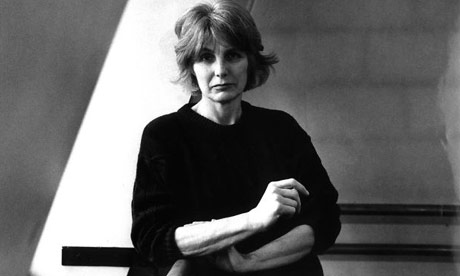
Caryl Churchill


Churchill is an incredibly adventurous talent from the glut of ambitious playwrights known as the modern socialist dramatists. David Hare, David Edgar and Howard Brenton - among others comprised the MSDs. All had a social conscience and an impressive flair for experimental theatre, but Churchill undoubtedly wears the crown for the female vanguard of innovation.

Churchill is considered so because she's lyrical and historically erudite as well as deconstructing. She can mould characters from one act into another, crossing centuries and gender as she does so, (as in Cloud 9 from 1978) and she expects the audience to work hard at keeping up - or fail to grasp the message of the play. Churchill doesn't pander to or placate the lazy audience. You pay your money and then you start work.

Top Girls collates women from different centuries, religions and ethical bases and puts them at the dinner table - with one thing in common: they're all miserable. Written in the early 80s, this is clearly a wafer-thin smokescreen for the dawn of Thatcher's Britain, and is the era in which the second half is set.


The play opened in 1982 at the Royal Court in London, and Churchill was annoyed by a certain female journalist's write-up. The assumption by Julie Burchill that the play discouraged women from working because, frankly, it's all too miserable, annoyed Churchill. She responded by saying the work was a comment on the failure of capitalism to fulfill basic needs in general, gender notwithstanding.

Churchill is known for her non-naturalistic writing, feminist themes and the questioning of personal and political power. Under the loomingly dark and earnest subjects of her plays, there shimmers inventive prose.


In Far Away - a play oft-collaborative director Max Stafford-Clark described as 'an elliptical, political fable, surreal and powerful', the character Joan asserts:

And I know it's not all about excitement. I've done boring jobs. I've worked in abbatoirs stunning pigs and musicians and by the end of the day your back aches and all you can see when you shut your eyes is people hanging upside down by their feet.

Her imagery is powerful and lingers long after a scene change.

Caryl Churchill (born 3 September 1938, London)

Wednesday, 8 June 2011

Suze Rotolo


Dylan's girlfriend for three years during the early 60s, Rotolo was the daughter of American Communists, and it was this unusual upbringing that shaped her values. She had an innate wish to explore and question American cultural and civil matters.

With this background, it's not surprising she wouldn't lose her identity to Dylan during their close and mutually beneficial relationship.

Her creativity and interests continued to develop during their time together. In fact, she introduced Dylan to the work of French poet Arthur Rimbaud, and it was during her time as a theatre lover and set designer that she pointed him to Brecht. They were both writers that were to be forceful influences on his own work.

Rotolo, increasingly worn down by a need for individuality in the midst of an escalating and claustrophobic fame package, moved further into an interest in civil rights, and ultimately away from Dylan. Torn, she chose further study over loyalty to him and eventually, unsure of a future with a dreamy and evasive man, she left to study in Italy for six months. During this time, Dylan wrote 'don't think twice, it's alright' about her.

In her excellent autobiography A Freewheelin' Time: A Memoir of Greenwich Village in the Sixties she accounts for their break-up gracefully. When Dylan began spending more time with Baez - professionally at first, and then casually but totally, she covers the events without bitterness; this being only a small part of her story.

Rotolo had a talent for writing and she wrote about her life easily and lucidly. In terms of her career, her book art sold until the end of her life.

A New Yorker and the girlfriend of a legend, she was foremost a child of immigrants – those who had had it tough, and consequently she never lost that feeling of being on the periphery. She said of her difficult childhood: 'But it's not until adulthood that you realise how cruel life is', and here her sadness is shown in her choice of words - not 'can be' but 'is'. She always felt she needed to work that little bit harder and not forget how to be in control of her own future.

Suze Rotolo (born November 20th, 1943)

Friday, 20 May 2011

Hazel O'Connor


As a kid, Toyah and Hazel O'Connor were my role models.

In my defence, there are reasons why I sometimes conflated the two in my young brain. Both Toyah and O'Connor were ex-art students and singers with a commercially diluted punk bent, and both were influenced by Bowie.

With hindsight we know Toyah's presence on our screens has been longer lasting - having enjoyed better luck than O'Connor, and Toyah has revelled in a successful stage career (the highlight being to star alongside Laurence Olivier).

But O'Connor has the edge as a recording artist.

A big break in the form of a lead part in Breaking Glass (1981) propelled O'Connor to almost instant stardom – but only for a while. In fact, O'Connor was set against Toyah for a role in the film. Toyah wasn't selected, and after some internal rearranging, O'Connor was chosen to be the lead. Toyah - already established as a result of appearing in Jubilee and Quadrophenia, wasn't the appropriate choice for a rock star on the rise.

It was O'Connor's time to shine.

The film charts a young punk star - Kate's rise to fame, and ponders the theme of fortune being a poisoned chalice. Kate - a young woman coming up against a formidable and manipulative record industry – was a plot that was to strangely mirror O'Connor's own career.

As a result of her uncommonly brutal and protracted disputes with her record company Albion, O'Connor didn't fully have the chance to develop artistically. Her legal grievances escalated over the years, and as they did so - in an age-conscious world, she grew older and less marketable.

The tedium of legal dealings - invariably and understandably ate into her creative fervour, and this is a shame because we'll never know how good she could have become.

She was persecuted. Signing her record contract when stressed and upset, she made a wrong move that was to have diminishing consequences. Having first taken legal advice (and she was sternly told the contract wasn't worth the paper it was written on) she made the mistake of ignoring this advice. Protracted skintness and a subsequent low moment, meant she signed along the dotted line.

In the ensuing years, what happened to O'Connor would have been enough to send anyone bitter. Whatever she earned was greedily taken back from her. Her label justified their behaviour by saying money should be clawed back to cover recording and touring expenses. This meant O'Connor worked extremely hard – almost to breaking point, and was left with nothing:

'I haven't got any money still. I'm not going to have any money for years, if ever. There were times when I thought if I wasn't naturally strong I might have done myself in...At one point I had writs arriving every week. Such bastards! How dare they treat me like this.'
O'Connor 1985

Will You is one of the best tracks of 1981 - which is praise indeed, because it was a particularly strong year for unusual and brave chart music. In a short space of time, and musically at least, she eclipsed Toyah. She was capable of innovation - producing lasting songs that were richer and texturally denser than Toyah's forgettable ditties.

But on the back of most of her singles - industry crimes against her aside, it remains questionable whether she had the raw talent to go the distance. She did though, have moments of undoubted accomplishment.

On balance, Will You is partly a stand-out song from her short career because it's unlike most of her others: it is very good indeed.

Will You has more than a smudge of Patti Smith in the vocals. As with If Only, this Patti Smith emulation is a credulous style choice, and perhaps she could have further developed this tonal quality. But just how good she could have been – or not - we shall never know.

Hazel O'Connor (born 16 May 1955, Coventry, England)

Monday, 16 May 2011

Judy Blume


Judy Blume is an American author for the teen market.

Judy Blume was someone who spoke on your adolescent level, and she understood what you couldn't bring yourself to chat to your nearest and dearest about. Even your own mother didn't seem to know what was happening to you. Compared with the daring, empathetic scribblings of Blume, your own mother was a veritable stranger.

And this is why she was both special and popular. Children aren't Disney characters - they're real, making sense of a confusing world. She was the first to realise this; she knew your mind and she spoke to you accordingly. Her books for children and young adults have exceeded sales of 80 million, and been translated into 31 languages.

Blume's novels for teenagers were among the first to tackle matters such as racism (Iggie's House), menstruation (Are You There God? It's Me, Margaret.), divorce (It's Not the End of the World, Just As Long As We're Together), bullying (Blubber), masturbation (Deenie; Then Again, Maybe I Won't) and teen sex (Forever), and as such have been the source of controversy over the appropriateness of such topics for the audience they reached.

But before Jacqueline Wilson took over the teen lit crown, she was your friend in need and a lovely pal indeed.

You didn't want to talk to your sister about breasts and sex, did you? And I know I'm not the only one to have Margaret's mantra, 'I must, I must, I must increase my bust' etched in my brain for evermore. Bust? How quaint.

Judy Blume (née Sussman; born February 12, 1938).

Monday, 4 August 2008

Vashti Bunyan


"Why should you say I could love any man, have his children and still be free? Go on voting, striking and fighting. Go on searching, fighting and loving."

How Do I Know.

As a lyric in isolation, this sums up everything that draws me and concerns me about feminism. Men and women both work these days, and earn roughly the same, but while being born female is fate, motherhood is made the destiny of a lot of women. It's a privilege to have somebody to care for, but motherhood also seems the ultimate prison. All mothers are single mothers at the end of the day. Once that decision to be a mother has been made, there's no turning back. It's nothing less than traumatic. Yet, we're still pretty much expected to make that transition of freedom to non-freedom.

Vashti Bunyan wanted most of all in life to be a pop singer - something she still upholds as being the dream she had for herself. What she did instead was release some folk tunes, then turn her back on what she saw as her ambition failure, to take two years to head to Donovan's commune in the Isle of Skye. It took two years for her to get there, and by the time her and her boyfriend Robert arrived, it had closed down. Still, some spiritual wisdom: it's all about the journey, not the destination - and this inspired an album.

Nonetheless, her and Robert set up home and raised children together, but Vashti didn't sing again for 35 years. The reasons aren't completely clear. Perhaps she didn't feel like it. Arguably she was just content with family life. She busied herself in domesticity - which she enjoyed, but there was still a renunciation in place. Her children knew snippets of their mother's past, but she never so much as sang to them.

Still, it was wanting to share her past with her children, and the advent of the Internet (which made clear to her how much she had grown into cult status in the meantime, and also just how many of those scratchy old tapes were issued in compilations) that prompted her to make a new album, entitled Lookaftering. Making this album was an experience she enjoyed returning to.

And, yes, in her own words, she felt like a flower unfolding after all that time.

Listen to this. Buy this.

Vashti Bunyan, born in London in 1945

Friday, 18 July 2008

Ruth Madoc


Did you know Ruth Madoc went to RADA?

Did you know she played Fruma Sarah in the film Fiddler on the Roof? Did you know she looks and sounds spookily like my Mum (especially in the 80s when Mum had her trademark short, straight hair, and her accent was at her strongest)?

We remember her as the 'vamp from the valleys' in Hi de Hi, of course, and the Wispa ad - with her longed for love object, Jeffrey. Actually looking again at that ad, she's hot - what was Jeffrey thinking? Jeffrey, the gauche, bumbling Hugh Grant of his time - with all the passion of a wet Pontins' tea towel, was an unworthy longed-for suitor. Was he really worth hanging around in a banana coloured uniform for?

On stage, Ruth has done everything from Shakespeare to musicals - co-starring with the late Harry Secombe in Pickwick, and even portrayed an 80-year-old Jewish mother in Gypsy.

She played the daughter's role in the stage version of A Taste of Honey, and while no Tush, I bet she was great, and was less of a mousy victim than Tushingham's foray. It would have been interesting to see.

In 2000 she played the role of Mrs. Ifans in Very Annie Mary alongside fellow Welsh actor Jonathan Pryce.

But life was not always smooth for Ruth. She was brought up by her Grandparents in a small Welsh town near Swansea because her parents were nomadic and couldn't settle to a life of child-rearing.

She was, and still is, greatly loved as a symbol of Welsh freshness with anyone old enough to remember balancing a French Fancy on their knee, while tuning into Hi-de-Hi.


Ruth Madoc, born 16 April 1943 in Norwich but brought up in Llansamlet, near Swansea.

Thursday, 19 June 2008

Floella Benjamin


Did you know Floella was the first to appear fully pregnant on British TV (in Play School)?

For a woman whose ambition was to be Britain's first black bank manager, her life took a totally different course. There just weren't black bank managers back then, but ethnic minorities were accepted into the theatre, and so that's the way she went.

There weren't many black people on TV during the 70s and 80s. The TV channels were becoming more senstive to the fact - especially in representing children - firstly in the 60s and later on with Derek Griffiths, but in the main, they were vastly outnumbered. Notwithstanding, she thrived on television. The main allure of her was that she genuinely loved being around children. She wasn't merely adorning the shop floor for the career bump-up.

Sourcing pics for this post, there were hundreds of her, and not one without her beaming.

Floella starred in two of the upper echelons of Play for Todays, from one of its golden eras (the late 70s). In 1979, she starred in A Hole in Babylon, about a seige in an Italian restaurant that goes wrong. Waterloo Sunset, (also 1979, the year that brought us the dazzling
performance of Jonathan Pryce in Trevor Griffith's 'The Comedians') is a play about racial disharmony in a poky London flat. A young man and his elderly relative live on a mostly West Indian London housing estate and the pivotal scene involves the naive old woman dusting her face with cocoa in order to fit in, but they take it the wrong way.

A few years prior, in 1975, she starred in another Play for Today, The Floater - where she was lucky enough to appear alongside Richard Beckinsale (who played a solicitor's clerk acting for his sick wife).

She also appeared in many films (mainly playing a nurse) but 'Black Joy' is a film of note about a naive African immigrant arriving in Brixton - with Norman Beaton as the wise-arse, no-good rude boy she falls in with. Floella plays Beaton's non shit-taking wife. Vivian Stanshall's in it
too, as a pervy vicar.

In more recent years, she was cast in Doctor Who and there's the Floella Benjamin Award at Exeter University (which also gave her an honoury doctorate), where up to £1,000 is given to promising students to help improve their future job prospects.

Predictably, but admirably, she runs a lot for charity these days.

Floella Benjamin OBE (born in Trinidad, 1949)